Thimphu, Bhutan | 22 May 2026
An international workshop on “Risk Accounting and Community Resilience in Climate-Sensitive Agrarian Socioecologies of the Hindu Kush Himalayas” was successfully held on 22 May 2026 at Jambayang Resort, Thimphu. The event brought together policymakers, researchers, technical experts, and community practitioners to strengthen dialogue on climate risk, loss and damage assessment, and resilience-building in mountain ecosystems.
The workshop was organized by the South Asian Forum for Environment (SAFE), India, in collaboration with Progyan Foundation for Research and Innovation (PFRI), India, and the Bhutan Ecological Society (BES).
The programme was held under an Asia Pacific Network for Global Change Research( APN)-funded regional project aimed at developing evidence-based systems for risk accounting and loss and damage assessment in climate-sensitive agrarian landscapes across India, Nepal, and Bhutan.
Participants engaged in discussions on the increasing climate-related risks affecting the Hindu Kush Himalayan region, including shifting temperature patterns, erratic rainfall, floods, landslides, and changing water availability, all of which are impacting fragile mountain farming systems and local livelihoods.
The workshop also provided a platform to:
- Introduce the project framework and planned interventions
- Facilitate multi-stakeholder dialogue on existing risk assessment practices and policy gaps
- Gather inputs for developing a context-specific loss and damage accounting framework for Bhutan
The workshop is expected to contribute to stronger evidence-based climate policy, improved risk assessment systems, and enhanced community resilience planning, particularly for marginalized agrarian communities in the Himalayan region.
A total of 26 participants representing government agencies, research institutions, and civil society organizations attended the workshop, reflecting strong national engagement on climate resilience and sustainable development priorities.
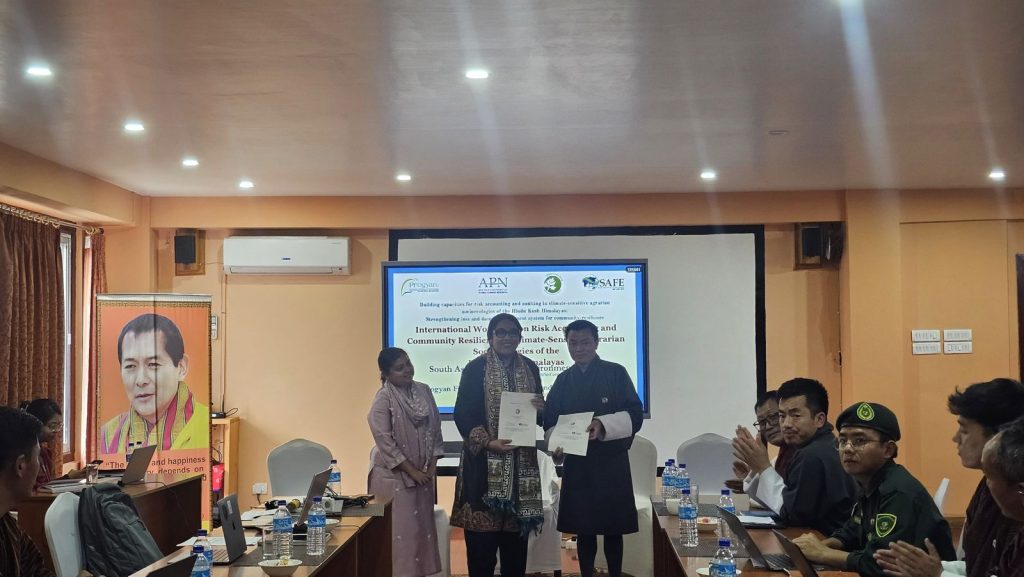
During the event, BES and SAFE further strengthened their collaboration through a Memorandum of Understanding (MoU), focusing on joint research, knowledge sharing, capacity building, and development of innovative climate solutions.
The workshop and partnership mark an important step toward advancing evidence-based policy, regional cooperation, and community-driven climate resilience efforts in the Hindu Kush Himalayan region.