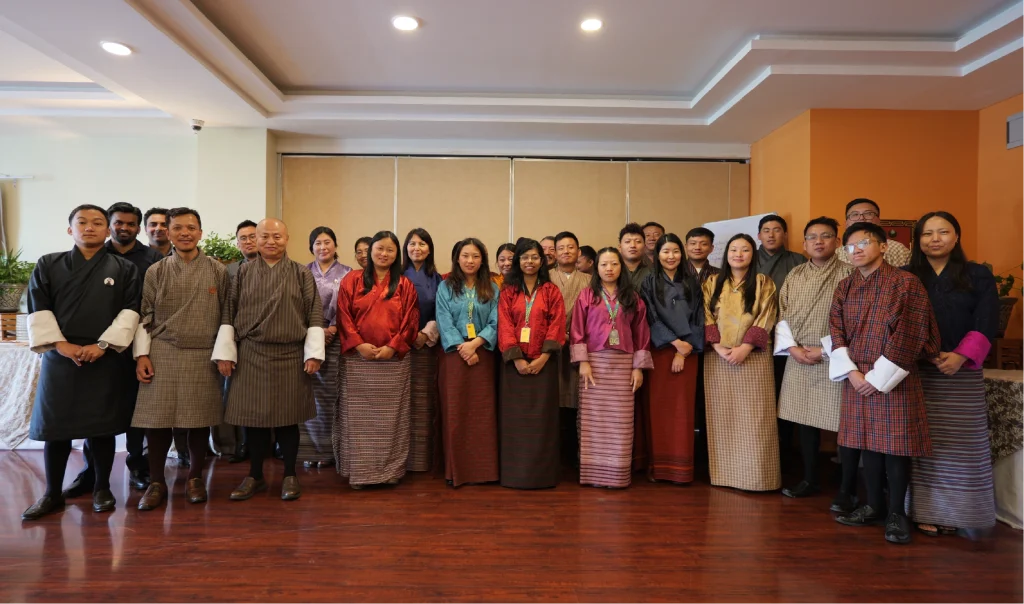

Bhutan Ecological Society, under the project titled Women’s Empowerment through Renewable Energy-Powered Lift Irrigation Systems in Bhutan (WERELIS–Bhutan), in collaboration with Department of Energy and International Centre for Integrated Mountain Development (ICIMOD), with support from International Development Research Centre (IDRC), Canada, organised a one-day Training of Trainers (ToT) programme on the application of the Detailed Feasibility Study (DFS) Framework for Renewable Energy Irrigation Systems in Thimphu, Bhutan on 25 May 2026.
The WERELIS–Bhutan project seeks to establish the foundation for the wider adoption of renewable energy-powered irrigation systems by equipping decision-makers with evidence-based knowledge, practical tools, and scalable models. The project also aims to strengthen institutional and technical capacities to integrate gender-responsive approaches into the planning and implementation of irrigation systems.
To address inconsistencies and gaps in existing assessment practices, a Detailed Feasibility Study (DFS) Framework for Renewable Energy Irrigation Systems has been developed. The framework offers a structured and standardised methodology for evaluating irrigation projects using multiple renewable energy technologies, including solar photovoltaic (PV), mini-hydro, and hybrid system configurations.
The framework incorporates technical design parameters, water resource assessments, financial viability analyses, environmental and social safeguards, as well as risk assessment into a comprehensive and unified approach. Its implementation is expected to enhance the quality of decision-making, improve project bankability, and ensure the long-term sustainability of investments in renewable energy irrigation systems.
With the framework now finalised, there is a growing need to strengthen both institutional and individual capacities for its effective application. The ToT programme was therefore designed as an initial step to enable key stakeholders to develop an in-depth understanding of the framework and serve as future trainers and practitioners to support its wider rollout across Bhutan.
The primary objective of the Training of Trainers (ToT) programme was to build the capacity of selected professionals to effectively understand, apply, and disseminate the DFS Framework for Renewable Energy Irrigation Systems in Bhutan. Specifically, the training aimed to:
- Develop a clear understanding of the structure, components, and methodology of the DFS framework;
- Provide practical knowledge on conducting comprehensive feasibility assessments for renewable energy irrigation systems, including solar PV, mini-hydro, hybrid, and wind-solar systems;
- Strengthen participants’ ability to evaluate the technical, financial, environmental, and social dimensions of irrigation projects;
- Build skills in applying standardised tools, templates, and methodologies to ensure consistency and reliability in feasibility studies; and
- Enhance participants’ capacity to train others through a cascade training approach and support the broader adoption of the framework across institutions.
A total of 30 participants representing various agencies, including the Department of Water, Department of Infrastructure Development, Department of Energy, Department of Agriculture, Electricity Regulatory Authority, private firms, civil society organisations, and ICIMOD attended the training. Women accounted for more than 44% of the participants. The training sessions were facilitated by a renewable energy design expert from Nepal.