Venue: Thimphu Deluxe, Thimphu, Bhutan
04 & 05 August 2025
Organizers: Department of Energy, Royal Government of Bhutan, ICIMOD, Bhutan Ecological Society, International Development Research Centre
About the event
Agriculture employs 40% of the Bhutanese population, with women comprising more than half of the agricultural workforce. However, the sector’s contribution to GDP has been steadily declining due to a combination of climatic, environmental, and socio-economic challenges, threatening the country’s self-sufficiency in staple crops. Currently, only 20% of cultivable land is irrigated, highlighting a critical gap in agricultural productivity.
Bhutan’s traditional irrigation systems—mainly gravity-fed, open channels—are seasonal and increasingly vulnerable to climate change. The country’s mountainous terrain often necessitates lifting water from sources at a lower elevation, presenting both logistical challenges and opportunities. Bhutan’s abundant fast-flowing rivers present significant potential for renewable energy (RE)-powered solutions, such as decentralized lift irrigation systems—offering a sustainable and innovative path to expand irrigation infrastructure, particularly through sustainable and innovative solutions, and address pressing agricultural challenges. However, current efforts to harness this potential often overlook gender-inclusive and gender-responsive strategies, limiting the equitable participation of women and marginalized groups in the irrigation sector.
Women’s Empowerment through Renewable Energy-Powered Lift Irrigation Systems in Bhutan (WERELIS – Bhutan) project seeks to address these gaps. The project is implemented by ICIMOD in collaboration with Department of Energy, Ministry of Energy and Natural Resources, Royal Government of Bhutan along with field implementing partner Bhutan Ecological society. The project is funded by International Development Research Centre (IDRC), Canada.
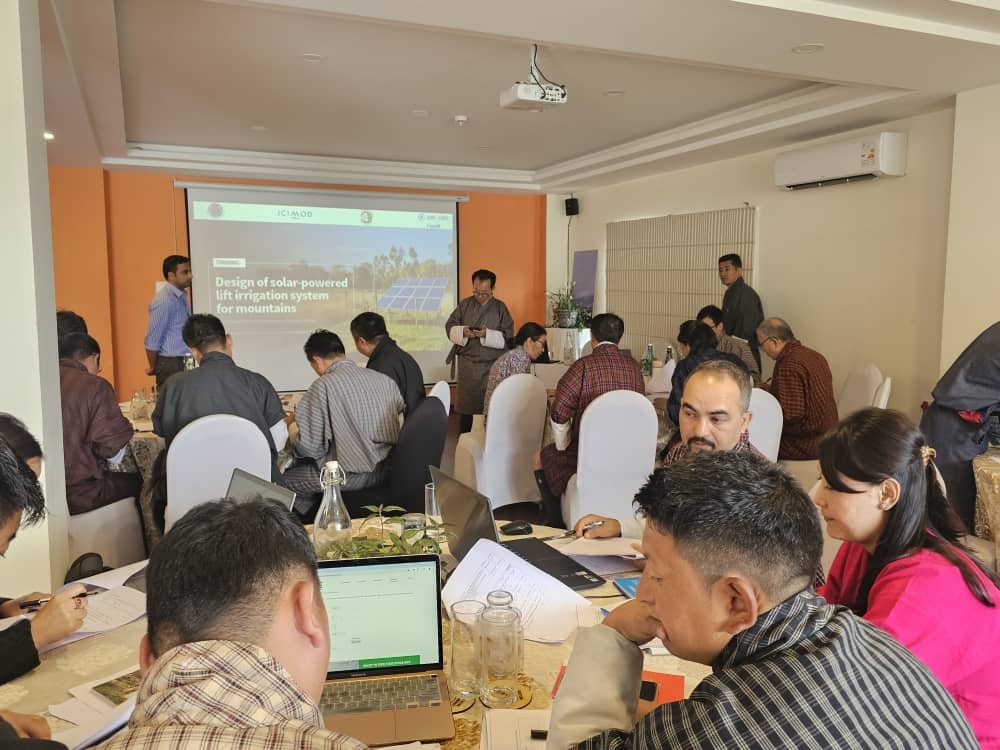
The WERELIS initiative has organized a two-day (4th and 5th August, 2025) specialized design training for engineers in Bhutan, enhancing their technical expertise in solar-powered irrigation systems. This capacity-building program equips participants with critical design skills, helping bridge the gender gap in renewable energy for irrigation.
Objective
Bhutan’s irrigation sector faces a critical shortage of skilled professionals, particularly women, at all administrative levels. This gap undermines feasibility studies, system design, construction oversight, and long-term maintenance—limiting modernization and adoption of solar PV irrigation. To address this, a two-day training program has been designed to prioritize and strengthen the technical capacity especially women engineers, ensuring their active participation in the sector.
Training Objectives:
• Provide foundational knowledge on solar-powered lift irrigation systems.
• Explain the working principles and sizing of key system components.
• Equip women engineers with the skills needed to lead in design, implementation, and maintenance of sustainable irrigation solutions.
By focusing on technical and leadership development, especially on women candidates, this initiative aims to bridge the gender gap in modernising the Bhutan’s irrigation sector.
The 2 Day intensive training was attended by 33 participants from various governmental agencies (Department of Energy, Agriculture, Infrastructure, etc), Technical Taining Institute, and private firms (J.B.Solar and Kinley Chimi Construction). The training was rendered by Mr. Kusha Gautam, Renewal Expert from Nepal for the project, supplemented by Mr. Mewang Gyeltshen, Sr. Renewal Energy Specialist from ICIMOD. The theoretical session was followed by various exciting exercises on the designing and use of various softwares of the solar system. At the end of the training all the participants were awared the certificate of participation.